
The potential of sorghum
2022. October 22.In Hungary, besides cereals, the cultivation of maize is perhaps the most important and has the longest history, since it is one of the basic fodder crops, of which we cannot produce so much that it cannot be sold either domestically or on the world market.
In the past, the cultivation of so-called broom sorghum was predominant in the domestic context, but the balance is shifting towards the gradually gaining ground in the production of fodder sorghum.
However, it is not the aim to replace maize, but in areas where maize is risky because of drought, it is worth switching to grain sorghum.
This means that up to 100 hectares of land in our country are available for this purpose.
Sorghum as an option
Farmers should think about their options and start growing this tall, broad-leaved grass on a small area on a trial basis.
This is also important because no one can afford to stand on one foot any more, and new ways, new livelihoods and stability in agriculture must be sought.
To do this, the first step is to gather useful information on sorghum, so that they can change their current cropping structure.
Recently, at a professional event, experts gave advice on how to start, continue and expand sorghum production.
It was said at the event that sorghum was already being grown in this country more than ten years ago, when it was about.
5 thousand hectares.
Three or four years ago, 23 hectares were sown with sorghum, which has been gaining ground ever since.
Alongside grain sorghum, silage sorghum has also become popular, with the two crops now being grown on a total of 35-45 000 hectares.
However, in order to be able to feed livestock safely and in sufficient quantities, the area sown would have to be increased further, up to 200 hectares.
The drought in Hungary has been increasing in recent years and is lasting longer and longer, so it is essential to adapt to changing conditions and to rethink and rethink the sowing structure.
We need to include crops that can survive in this climate and can also be used as animal feed.
At the moment, France is the country with the largest cultivation of this crop, along with Italy, and since our country has a similar climate, we have a good chance of starting to include more and more land in sorghum production.
However, it is essential to acquire the necessary technical knowledge and the right seeds.
Market opportunities
The key question is whether there is a long-term market for this crop, whether it can be sold, whether there is a demand for it.
The marketability of sorghum is influenced by its quantity and its long-term availability, i.e. its continuous availability.
If these conditions are met, the crop will be saleable. 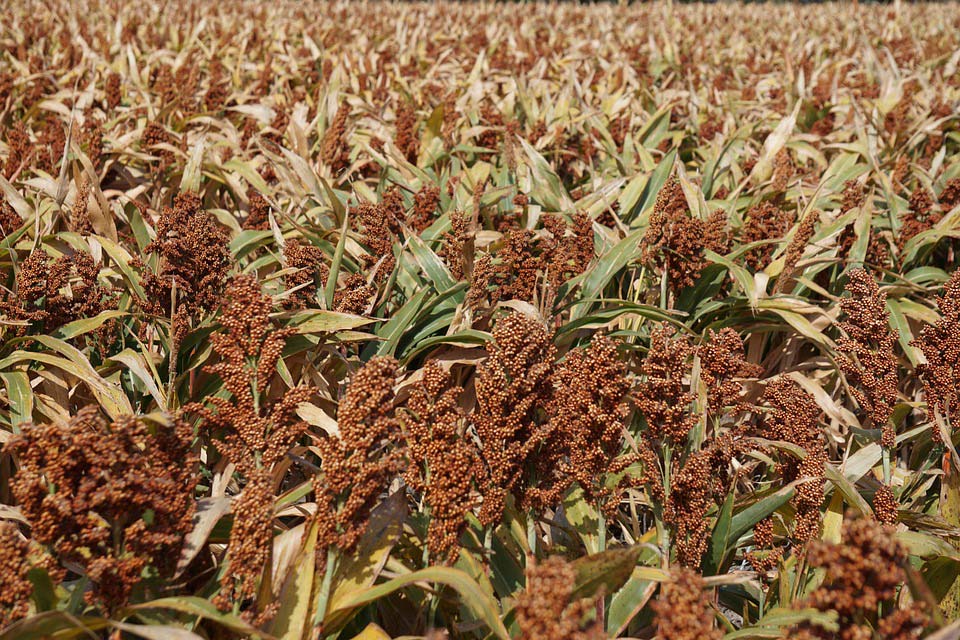 An experienced professional, who has been producing sorghum seed for more than thirty years, says that although there were problems at the beginning, everyone was familiar with this useful crop with high nutritional value.
Selling it was difficult because farmers found it difficult to change the way they fed their animals and, at that time, they did not yet see a steady supply.
However, this wall has been broken down and the crop is now increasingly used as fodder, so it is worth trying to grow it because it can be sold at a good price.
Lately, livestock farmers have also been looking for this source of nutrients, so the demand side is also becoming more and more important.
New uses for sorghum
Not only can sorghum be used as animal feed, it can also be used for human consumption, as it can be used to produce gluten-free sorghum flour.
Puffed sorghum is also in demand and popular among nutrition-conscious people, and children enjoy eating it.
The necessary milling processing background is available.
Beer lovers can also rejoice, as gluten-free beer can now be made from this wonder plant.
However, sorghum should not be grown without the necessary expertise, as knowledge of the technology is essential to achieve a good yield.
If conditions are favourable, a yield of 7-8 tonnes of sorghum per hectare is acceptable, but this can be increased to 10 tonnes.
In any case, it is economical to grow it, as once you can harvest 2 tonnes per hectare, the costs are recovered.
And the additional quantity is pure profit.
Fast harvesting
The peculiarity of sorghum is its constant growth, which in practice means that it grows until it is harvested, but it is also capable of continuous regeneration, taking nutrients from its seeds and producing spikelets – with the direct consequence that the yield is inferior in quality and quantity.
Because of its high protein content, it can replace maize.
It also has a similar intrinsic value to maize, which makes it a good mixing feed.
It also has excellent cultivability because of its resistance to pests.
It is also in great demand abroad because animals thrive when fed it.
It is therefore a profitable crop to grow and the climatic conditions in our country are optimal.