
Acreage ratio guide: which machines to buy for 50, 100 or 200 hectares
2025. July 30.When a farmer finally decides to buy a new machine, the first question is always how much land he wants to cultivate. The performance of the machine, its capacity, its useful life and its return on investment all depend on the number of hectares, so there is no universal recipe, but instead it is worth breaking down the decision into well-defined categories.
In this article, we’ll help you find the perfect machine for the job.
The family farm: 50 hectares of usable machinery
The area of around 50 hectares is usually cultivated within family farms. Here, the aim is mainly to develop a cost-efficient machinery fleet. Plenty is sufficient, but there is no need for an oversized solution; instead, look for machines that are easy to finance and sustainable.
For a farmer working on such a large area, a compact tractor with 50-80 hp, capable of handling tillage, combine harvesting, spraying and trailer transport, is an essential part of the optimal fleet. This power is sufficient to tow 3-4 m wide cultivators or seed drills, and meets the needs of a versatile farm with a small sprayer or fertiliser spreader.
A combination disc or subsoiler is often enough to prepare the soil, which is economical and simple, and a medium-sized seed drill is used for sowing. For spraying and fertilising, an 800-1200 litre ISOBUS-compatible sprayer will be the optimum choice, and this may be sufficient for the needs of a small farm. And for harvesting, ideally, a small machine rental can help to avoid the need to own and maintain an expensive combine harvester. In this category, fewer machines usually means more, with a lower investment and lower maintenance costs, while ensuring that the most important tasks can be easily carried out.
Precision farming on a medium scale: for 100 hectares you need bigger machines
An area of around 100 hectares already offers the possibility to operate more powerful machines economically. This is where the benefits of precision farming, such as GPS, AutoGuide systems and yield meters, can be seen to easily improve the efficiency of machine use.
The recommended basic machine is a mid-range tractor with 100-150 hp, suitable for towing large working width implements (e.g. 5-6 m seed drill, subsoiler). For soil cultivation, however, it may be worth using a combination of implements to prepare the soil for winter sowing. For both sowing and soil treatment, a medium-width seeder is needed, and for spraying and fertilising, a 1500-2000 litre unit may be ideal.
When harvesting, a 230-300 HP combine can cover the entire 100 ha in just a few days, so the farm doesn’t have to think in terms of machine days, just enough capacity. In this size class, in addition to the return on investment, the quality of the work, tolerances and the networking (e.g. monitoring, contracting, operation) all play an important role, and these farms have a stable income base.
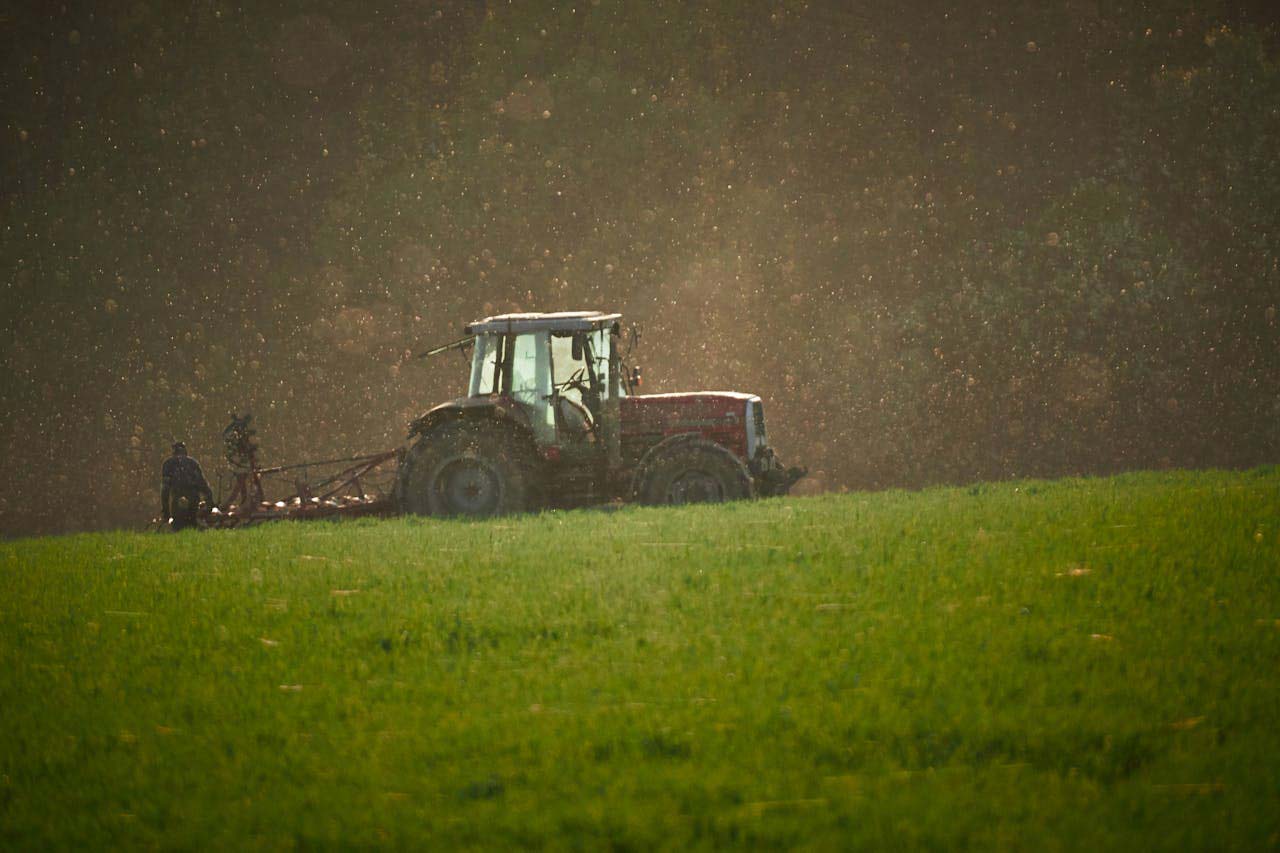
Professional tools for a large economy
A farm of 200 hectares or more is already a major agricultural enterprise, with a strong infrastructure and continuous work. This requires high capacity equipment and high machinery utilisation.
The fleet is based on a 200-300 horsepower tractor that can cope with large ploughs, backhoes and front-end loaders without feeling undersized. However, sowing should be done with an 8-10 metre seed drill, which can reduce sowing time and increase the utilisation of machinery.
As far as spraying is concerned, you will need a machine of over 3000 litres. Harvesting often requires two combines, which can work side by side. This helps both speed and mechanical safety. Ideally, the farm will have a front loader, forklift and its own workshop to maintain the machinery.
On a larger farm, farming is intensive, costs are higher, but the return is faster. Where machinery is working up to 300-400 ha or more per year, the per hectare asset requirement can be significantly lower than for a smaller farm. Not to mention that technological investments, such as precision systems, Gantt planning or expert advice, can already be a clear advantage.