
What mistakes can you make when baling?
2024. June 25.Although you might think that baling is not an art, that anyone can do it, if you think about it, we have certainly made mistakes in the process.
The stability of a bale net can be characterised by two things: the maximum breaking force, i.e. the point at which the net is about to break, and the elongation associated with that point.















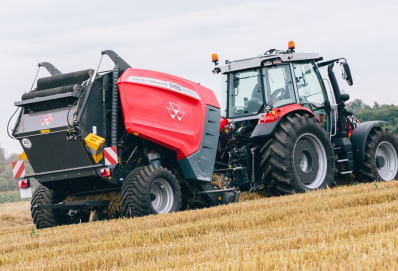


Below we will discuss in more detail the mistakes made during baling.
Why is this necessary?
The nets used for baling allow the bale to expand as it falls out of the bale chamber, making the warp of the net easier to arrange and perfectly fitting the size and shape of the bale.
However, it is not a good thing if the net stretches too much, as it can easily become loose and fall apart.
The final result depends on the quality of the bale and the baling machine and bale wrapping material.
Practical experience has shown that a number of technical, application and human factors play a role in whether or not the bale is properly made and wrapped.
One of the main problems is the misplacement, creasing and bunching of the bale net, which can lead to imperfect coverage.
The solution is always to regularly check the positioning of the netting, the cutting system and, last but not least, the transfer roller.
What else could be a problem?
Another common problem is that the infeed and transfer rollers are not properly adjusted.
The speed should be adapted to the type of forage to be harvested.
While leafy forages such as hay and silage are flat, flexible and easy to compress, wheat, barley and oats are much harder to compress.
The problem can occur when the stalk is shorter and drier than average.
This is because compressed straw has enormous energy.
Once they are in round bales, they need more nets to keep them stable.
And compressed fodder is explosive, so you need at least 3-4 turns.
However, if the fibres are even coarser, more netting is needed to keep the bale really stable, ready for transport.  Another is the condition of the feed, which can also make things worse.
If the straw is not growing, is too short, or is dry and brittle, it will almost certainly break into pieces during baling.
In such cases the bale is even explosive, so at least 4 turns should be expected.
The net will travel a long way before it completely covers the bales.
If there are problems with feeding, the risk of injury is even greater.
It is no coincidence that a pre-season inspection is recommended, where the whole bale-net feeding system is adjusted so that it feeds the net uniformly.
Fewer turns will result in a weak bale and also prevent it from staying together.
Poor formatting and inadequate netting can all cause problems.
The centre of the bale is under much more pressure than the edges, not to mention that if the bale is not properly shaped, the centre will be under tension, increasing the risk of damaging the net.
Tightness of the bale net
Checking the tightness is an important rule.
This involves measuring the size of 10 of the cross-linking fibres that make up the structure of the net, both before and after use.
The maximum difference between the two values is 10 %.
The total amount of netting used must be on the outside of the bale.
If it is not completely covered, the bale will become enlarged, which may cause damage.
In fact, the outer layer of the bale may not hold its shape, may burst and eventually the feed may fall apart completely.
This requires checking the amount of netting in the finished bale and, in some cases, checking the net feeding system.
Balers can damage them, especially if the rollers are covered with dirt.
This can create an obstruction to the bale, making it difficult to exit the machine, which can also cause problems.
So, if necessary, remove any dirt or material that could cause damage to the bale to get the job done properly.